
I am committed to thoughtful, compassionate horsemanship and creating a space where learning feels safe and supported. I welcome the opportunity to work with you and your horse in a thoughtful, encouraging environment. ~Abbie
Whole Horse. Whole Picture.
Education • Training • Behavior • Movement • Bodywork • Hoof Care • Tack • Nutrition • Horsemanship
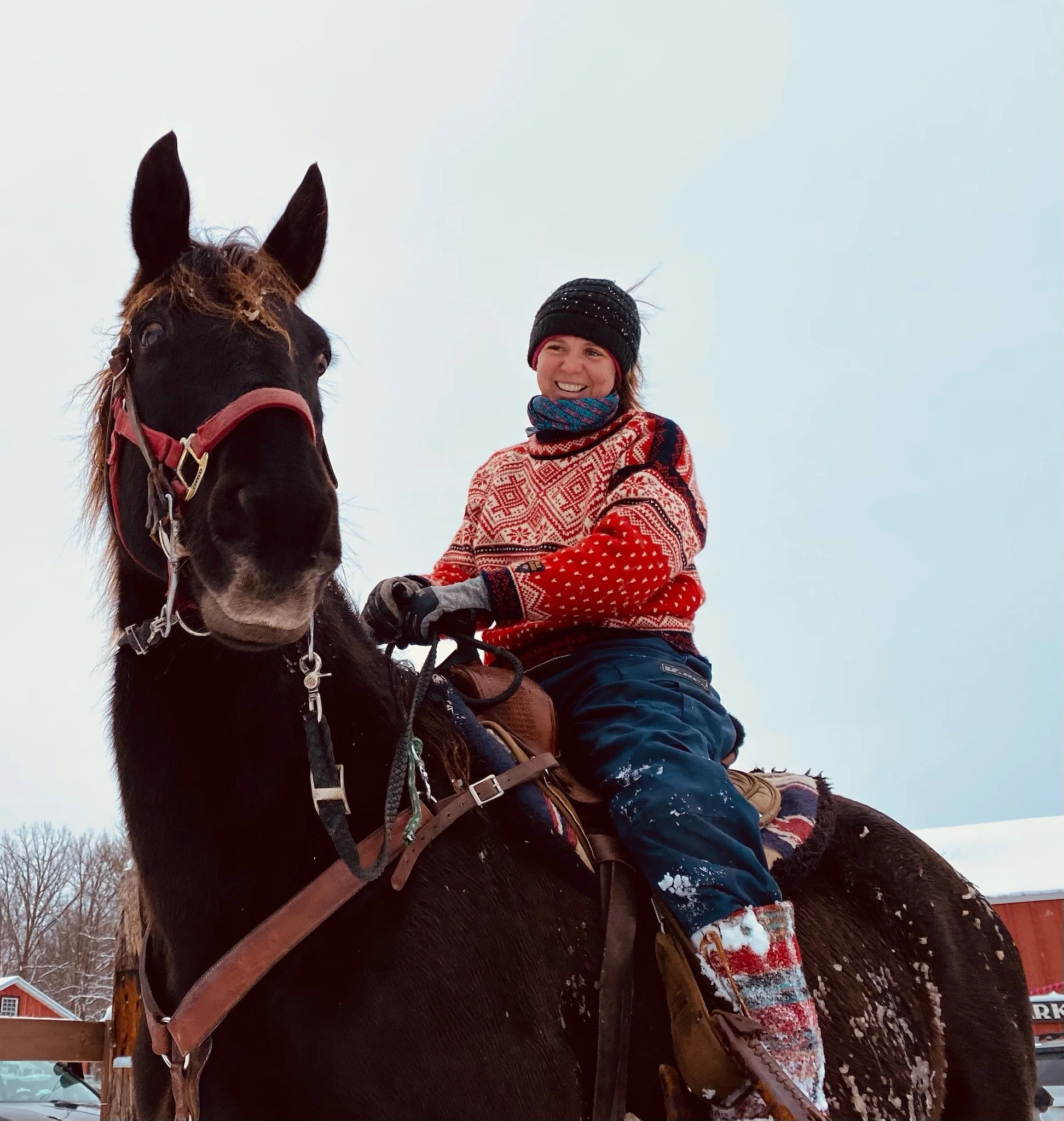
Hi! I'm Abbie Schramm,
There are more than thirty years of learning behind the way I look at your horse.
I have spent most of my life with horses, but I haven't spent it learning only about horses.
My path has taken me through education and psychology, veterinary medicine, farrier science, equine bodywork and anatomy, farming and animal husbandry, nutrition, business ownership, coaching, nonprofit work, and decades of training and teaching horses and their people.
At first glance, those experiences may seem somewhat unrelated. Today, I see them as pieces of the same puzzle.
They have taught me to look at the whole picture.
When a horse is struggling, I don't immediately assume it is a training problem. I look at posture and movement. I look at the feet. I consider the body, nutrition, tack, environment, previous experiences and the horse's mental and emotional state. Then I look at the human side of the partnership: experience, communication, confidence, expectations and goals.
Sometimes the answer is training.
Sometimes training is simply where the problem finally became visible.
The Experience Behind the Approach
I hold a Bachelor's degree in Education from the University of Minnesota Duluth, with a minor in Psychology, and spent nearly a decade working in education. My full-time teaching experience was at the high-school level, but I have worked with students from kindergarten through 12th grade. I also coached athletics and advised student leadership.
That background continues to shape my work every day.
Training the horse is only half of my job. If I can't help the person understand what their horse needs, develop the skills to provide it, and eventually become less dependent on me, I haven't finished my job.
I also spent nearly a decade working as a veterinary assistant in a mixed-animal veterinary practice, gaining hands-on experience with many species and a wide range of medical situations. Under veterinary direction, my work included animal handling and restraint, injections and IV medications, extensive wound management, surgical assistance, neonatal care, disease prevention, biosecurity and contagious and zoonotic disease protocols.
That experience did not make me a veterinarian, nor do I try to be one. It did, however, teach me to observe carefully, recognize patterns, ask questions, and understand when a training problem may warrant looking deeper.
I am also a Certified Farrier through the Oklahoma School of Horseshoeing and have pursued additional hoof-care education, including study with David Landreville/Hoof Builders focused on developing a healthy barefoot hoof that supports the entire horse.
My study of the equine body continued through becoming a Masterson Method Certified Practitioner. Certification required more than 400 hours of coursework, anatomy study, coaching, case studies and hands-on practice. Since certification, I have continued studying anatomy through whole-horse dissections and anatomy education with Trinity Equine Services, Avalon Equine and Equine Bodyworks USA.
Additional professional education has included NBCAAM-accredited coursework with Becky Tenges, including Beneath the Leather and Heart & Hands: Professional Presence and Practice, along with extensive saddle- and tack-fitting education.
I am currently continuing my education through Dauphin Horsemanship, working toward Master Bitting Certification.
Because good horsemanship also requires good humans, I have invested in creating an ethical, sustainable equine career with Karen Rohlf's Transform Your Business training for Heart-Centered Horse Professionals.
Thirty Years of Horses — and Many Ways of Learning
My education with horses began long before the certifications.
As a high-school and college student, I worked on a Tennessee Walking Horse breeding and training farm. I worked with breeding stallions, broodmares, foals and young horses and gained experience with reproduction, foaling, neonatal care, colt starting, showing and the management and training of gaited horses.
That experience became the foundation for what would eventually become one of my specialties: gaited horses.
It also exposed me to training and shoeing practices within the gaited-horse industry that profoundly influenced the kind of horsewoman I wanted to become. Seeing how manufactured movement could affect the horse strengthened my commitment to developing natural movement, relaxation, sound biomechanics and a horse that feels as good as it looks.
Over the decades, I have deliberately learned outside of any single discipline.
My continuing education has included dressage, ranch versatility, mounted shooting, cattle work, endurance, skijoring, driving, general horsemanship, gaited-horse education, saddle fitting, tack fitting, bitting, bodywork and biomechanics.
I have attended clinics, courses and educational events with a wide variety of horsemen and professionals and have spent years studying the work of people I admire. People who continually choose to put the horse first.
One particularly influential experience was attending the Best Horse Practices Summit in Lexington, Kentucky, where I was able to learn from professionals across multiple areas of horsemanship, veterinary care, bodywork, nutrition and equine wellness.
I don't follow only one trainer, one method or one discipline. I collect tools. Then I ask which tool best serves the horse standing in front of me.
Learning Beyond the Horse Industry
For roughly 15 years, my family and I operated a small sustainable farm while building our home and farm ourselves, including a period of living off-grid.
We managed dairy goats, Jersey cattle, heritage Red Wattle pigs, poultry and other livestock. That experience deepened my education in animal husbandry, reproduction, neonatal care, nutrition, pasture and land management, disease prevention and the practical realities of caring for animals every single day.
My husband and I have also taught and presented at sustainable-agriculture events, sharing our experiences with livestock management, dairy goats, soapmaking and building an off-grid farm.
During those years, I founded a goat-milk soap and natural body-care business. What began as a way to use excess milk became years of studying formulation, chemistry, product development, testing, troubleshooting and business management.
It may seem like an unusual addition to a horse trainer's biography, but those years reinforced something that has followed me into every part of my professional life:
I like figuring out why things work.
I am curious. I research. I look for patterns. I troubleshoot. And when the first answer doesn't make sense, I keep asking questions.
In 2022, I co-founded Soulful Horse, a nonprofit equine-assisted learning program with Stephanie Kirkham and Stefanie Arneson, to provide meaningful horse experiences for at-risk youth. The program reinforced my belief in horses as extraordinary teachers of self-awareness, confidence, responsibility and connection.
All of those experiences eventually came together at North Gait.
Some of My Greatest Teachers Have Had Four Legs
Formal education matters deeply to me. I have invested a significant amount of time, money and energy into continuing my professional development, and I intend to continue doing so.
But some of the most important education I have received has come from the hundreds of horses and riders I have worked with over the years.
One of those horses was Juno.
Juno came to me as an 18-month-old filly who had been described as difficult and slow to learn. And she was struggling. But instead of assuming she needed more pressure, more repetition or better discipline, we kept asking why. Eventually, Juno was diagnosed with severe spinal malformations and neurological deficits consistent with Wobblers syndrome.
She wasn't being difficult. She was doing the very best she could in a body that wasn't capable of doing what was being asked of her. Juno ultimately had to be euthanized.
I keep a braid from her tail and a photograph of her in my barn with a simple reminder:
“Remember, they're always trying.”
That lesson has stayed with me.
When a horse isn't progressing as expected, I want to know why.
When behavior changes, I want to know why.
When something doesn't feel right underneath me, I want to know why.
When a horse is labeled stubborn, lazy, reactive, difficult or dangerous, I want to know what the horse might be trying to communicate before I decide how to respond.
Sometimes the answer is physical. Sometimes it's emotional. Sometimes it's the equipment, the environment or a communication breakdown between horse and rider.
And sometimes I don't know.
Part of experience is becoming comfortable enough to say that — and knowing which professional we need to bring into the conversation next.
Whole Horse. Whole Picture.
Today, I see my role as more than simply a horse trainer. Often, I am a translator between the horse and the human. My job is to listen to what the horse is showing us, help the human understand it, and then give both sides of the partnership the skills they need to communicate more clearly.
My background in education helps me teach the person.
My psychology education helps me understand learning, emotion and communication.
My veterinary experience helps me recognize when we may need to look beyond training.
My farrier education helps me see the horse from the ground up.
My anatomy and bodywork education helps me understand how the horse is using — or protecting — its body.
My experience with nutrition, animal husbandry, tack, movement and multiple disciplines helps me look beyond any single answer.
And thirty-plus years with horses reminds me every day that there will always be more to learn.
I don't want to create horses that simply comply.
I want to help create healthy, comfortable, confident horses and capable, thoughtful humans who understand them.
Because ultimately, the goal isn't a perfectly trained horse.
It's a meaningful partnership built on relaxation, balance and trust.
Abbie Schramm
Education & Experience at a Glance
30+ years of horsemanship experience working across breeds, disciplines and stages of training
A. A. Degree, Central Lakes College
B.A. in Education, University of Minnesota Duluth
Minor in Psychology, University of Minnesota Duluth
Certified Farrier, Oklahoma School of Horseshoeing
Masterson Method Certified Practitioner (MMCP) — 400+ hours of professional education, case studies and hands-on training
Nearly 10 years in mixed-animal veterinary medicine as a veterinary assistant
Advanced equine anatomy & whole-horse dissection study
Continuing education in hoof care, saddle & tack fit, biomechanics and bitting
Master Bitting Certification — in progress, Dauphin Horsemanship
Extensive gaited-horse experience, including breeding, young stock, colt starting, training and natural gait development
Decades of continuing education across disciplines, including dressage, ranch versatility, cattle work, endurance, driving, skijoring and general horsemanship
Former K–12 educator, coach & presenter
Co-founder of Soulful Horse, an equine-assisted learning nonprofit for at-risk youth
15+ years of multi-species animal husbandry, sustainable agriculture, nutrition, breeding and livestock management